Competitive Socialising: Why the Next Generation Wants the Games Back in the Pub
Pubs have always been places to play. Darts, dominoes, skittles, crib, bar billiards, a pack of cards on a wet Sunday and, more recently, the pub quiz. Somewhere along the way the games went quiet, and the people who now want them most are the ones the industry worries about losing: the young. They have a name for what they are looking for. It is called competitive socialising, and it is the fastest growing way to spend a night out in Britain.
What is competitive socialising?
Competitive socialising is any night out built around playing something together: bowling, crazy golf, darts, shuffleboard, escape rooms, karaoke, quiz, bingo. The drink and the food are still there, but they are not the reason you went. The game is the reason, and the conversation happens around it.
It has stopped being a niche. Savills' Competitive Socialising Brand Tracker counts around 800 competitive socialising venues across the UK, up 58% since 2018. Multi-site operators alone run more than 500 of them, an 84% increase over the same period, and Savills forecasts the market will reach 1,100 sites by 2030 (Completely Retail News, December 2025). Indoor crazy golf has doubled to 100 venues on its own (Savills, Spotlight: UK Leisure Market 2026).
The numbers behind the boom
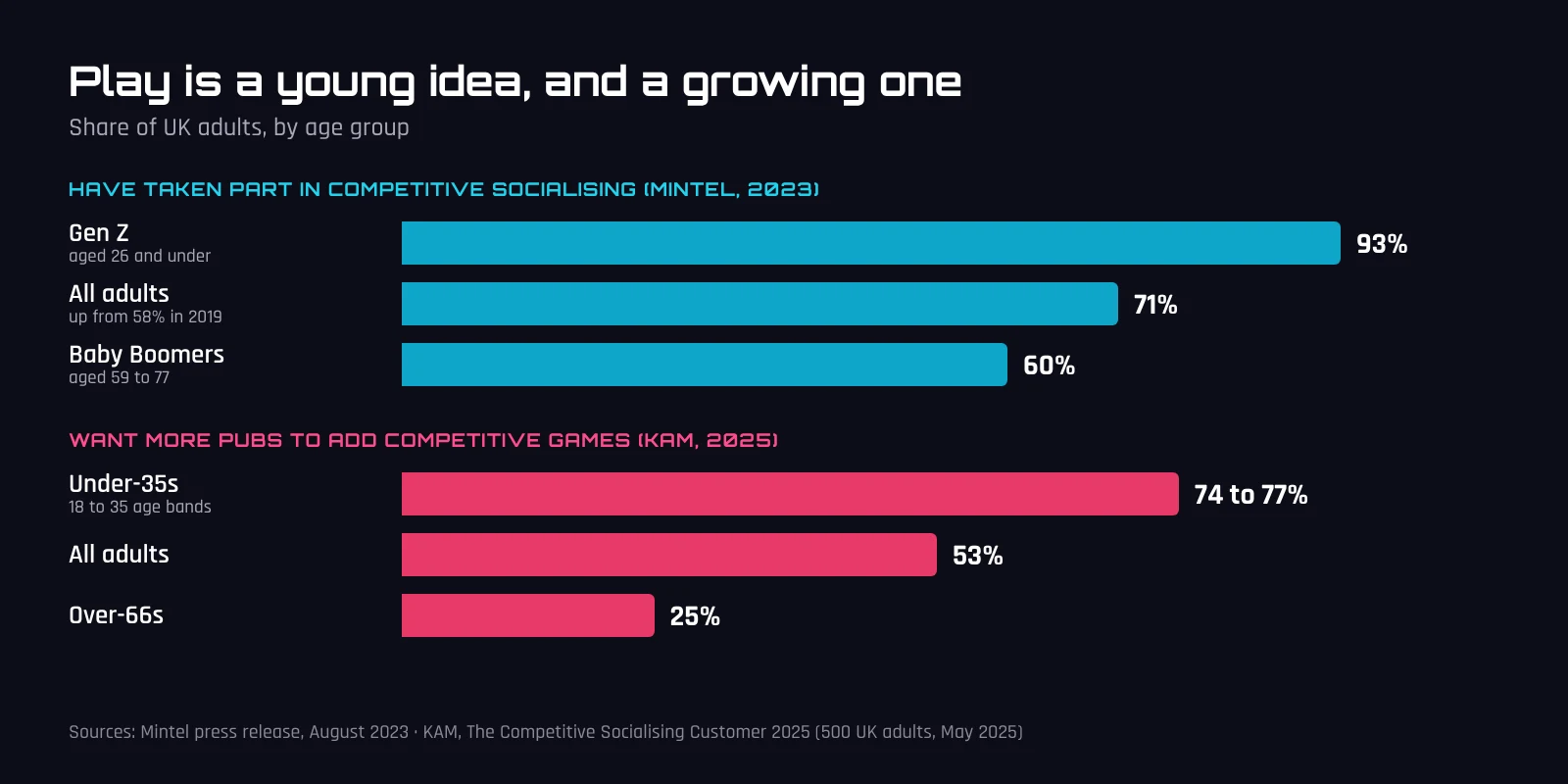
Mintel found that 71% of UK consumers have taken part in competitive socialising, up from 58% in 2019. Among Gen Z the figure is 93%. And in the month before the survey, 64% of Gen Z had played a social entertainment game, while 60% had been to the pub for a drink (Mintel, 2023). Read that last line again. For a generation of adults, playing something has overtaken simply going for a pint.
The habit is also deepening. KAM's 2025 study of UK adults found 29% had visited a competitive socialising venue in the past year, 41% of those visitors now go at least once a month, and 34% say they go more often than they did a year ago (KAM, The Competitive Socialising Customer 2025).
A generation raised on play days
Why is this happening now? Look at how today's twenty and thirty somethings spent their childhoods.
They are the first generation for whom a good day out almost always meant doing something. Birthday parties at soft play, then bowling, then laser quest, then the trampoline park. School holidays filled with activity clubs and play days. Weekends built around somewhere to go and something to do when you got there.
The industry grew up alongside them. Soft play was popularised in Britain by fast food chains from the 1980s, was "still in its infancy" here in 1995, and the British Association of Soft Play's membership has trebled over the past fifteen years (Emily Baughan, The rise and rise of soft play, 2024). A whole generation learned to socialise with a shared activity in the middle of the room.
They did not grow out of it. Adults and teenagers over 12, the so-called "kidults", now account for around a third of all UK toy sales (Retail Gazette, reporting Circana data, November 2025). Play is not something this generation is nostalgic for. It is something they still do, and they expect their nights out to make room for it.
Young people have not stopped going out
You will read plenty of headlines saying Gen Z have given up on the pub. The data says otherwise. CGA by NIQ found Gen Z make up 20% of the population but 28% of all on-premise visits, and Lumina Intelligence reports 18 to 34 year olds' share of drinking occasions rose 4.2 points in a year (Morning Advertiser, October 2025).
They still go out. They just want a reason to. A night that is only about the drink is easy to skip. A night with a quiz to win, a bingo card to fill or a music round to argue about is not.
There is a deeper reason too. The government's Community and Engagement Survey for 2025/26 found that 9% of 16 to 24 year olds in England feel lonely often or always, higher than the 7% average (GOV.UK, 2026). A game gives people something to do with their hands and something to talk about with strangers. That is exactly what a shy person in a busy room needs.
Games were always the pub's idea
Here is the good news for every venue reading this. Competitive socialising is not a new invention. It is the pub's oldest trick, rebranded and moved into warehouses with neon signs and bowling lanes. The darts league, the Tuesday quiz and the meat raffle were competitive socialising before anyone called it that.
Customers already see it that way. KAM found 64% of UK adults have been to a traditional pub offering some element of competitive socialising, around 80% of them said it was a positive addition to their visit, and 53% want more pubs to adopt it. Among under-35s, support runs at 74 to 77%, against 25% of over-66s (KAM, 2025).
The audience is asking for it. The question is how a local pub delivers it without a 20,000 square foot fit-out.
Why it matters for pubs right now
The pressure on pubs is real. Official figures analysed by the tax specialists Ryan showed 366 pubs in England and Wales were demolished or converted for other uses in 2025, taking the total down to 38,623, with nearly 2,000 lost over five years (Press Association via The Irish News, December 2025).
The pubs that thrive give people a reason to choose them on a Tuesday. CGA by NIQ data shared at The Pub Show found 43% of "high tempo" consumers now visit weekly, up 17 points in a year, and they spend £38 a month more on the on-trade than the average Briton. At the same event, a Stoke-on-Trent licensee described putting on a games night for under £100 and charging £5 entry, and the Royal Pier, which invested around £50,000 in snooker, virtual darts and shuffleboard, said Tuesday is now its second busiest night of the week (Morning Advertiser, March 2025).
Competitive socialising does not need lanes, oches or a five-figure budget. It needs a room, a screen, a host and a game everyone can join. Most pubs already have three of the four.
Why we created Let's Go Games
This is exactly the gap we built Let's Go Games to fill. The big competitive socialising brands have the budget for purpose-built venues. The local pub, the social club, the village hall and the community group have something just as valuable: the room, the regulars and a reason for people to come back every week. What they were missing was the game.
So we built one platform that turns any venue into a competitive socialising venue with nothing more than a laptop or tablet and the TV already on the wall. Players join by scanning a QR code on the big screen and play on their own phones, with no app to download and no account to create. The tech runs the cards, the scoring and the calling, so the room can do what it came to do: talk, laugh and compete.
It is the play day, grown up. The same buzz of a shared activity that a generation grew up with, in the pub they already love, hosted by people they already know.
What you get with Classic
Classic is our recommended plan for pubs, bars, clubs and anyone running regular nights. It covers one venue, or one self-employed host at any venue they run nights at, and includes:
- Bingo with phone play cards, auto-marking and instant win checking, so there are no disputed claims and no paper to print.
- Quiz with 16,000+ questions, an AI question generator and seven round types, from Speed and Picture rounds to Double Down wagers.
- Music Bingo with 36 curated playlists. The video plays on the big screen and the songs mark themselves on every player's phone.
- Let's Go Poll for live room votes, this-or-that questions, ratings and word clouds between games.
- Higher or Lower and Heads or Tails, quick phone-play games for the interval that keep the energy up while the next round is set.
Classic runs on 2 devices with up to 100 players at once, and costs £34.99 + VAT a month (£41.99 including VAT). Pay annually and you get 12 months for the price of 10, at £349.90 + VAT a year (£419.88 including VAT). More games are coming soon.
A week of competitive socialising, on one licence
- Monday: a team quiz to bring the regulars in on the quietest night.
- Wednesday: Music Bingo, the night the under-35s tell their friends about.
- Friday: big-screen Bingo with Higher or Lower and Heads or Tails between the games.
- Every night: Let's Go Poll to settle the room's arguments and choose next week's theme.
One subscription, one session code all night, and players never have to rejoin when you switch game. That is the competitive socialising night the next generation is looking for, run from the pub they already walk past.
Bring the games back to your pub
Classic gives you Bingo, Quiz, Music Bingo, Let's Go Poll, Higher or Lower and Heads or Tails for one venue, with up to 100 players on their own phones. £34.99 + VAT a month (£41.99 including VAT).
Get Classic